
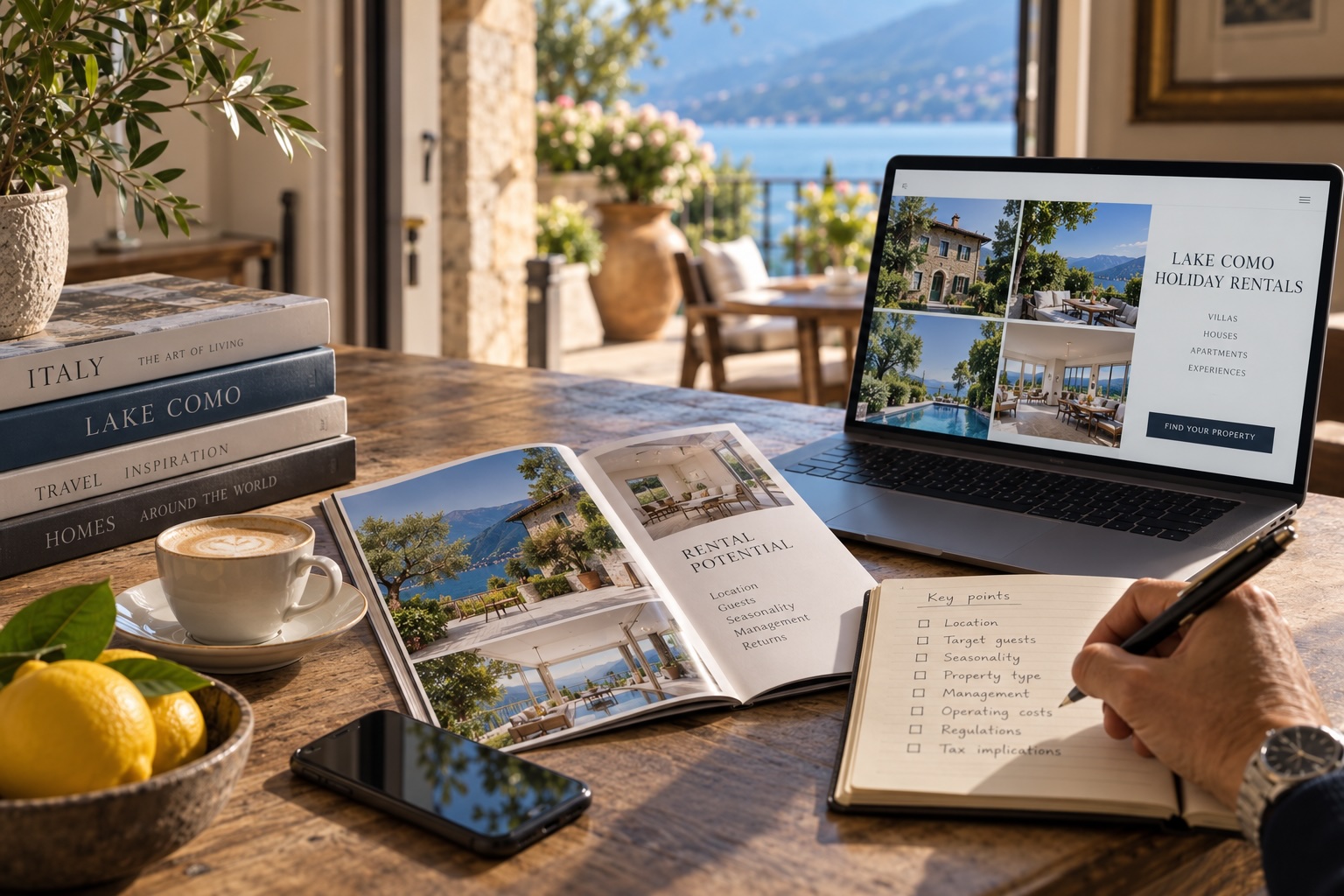
Buying a property on Lake Como with the intention of renting it for part or all of the year can be an attractive way to combine personal use with income generation. The lake has an exceptionally strong international profile, a long-established tourism market and a growing appeal beyond the traditional summer season. Yet owning a successful rental property here requires a more careful approach than simply choosing a beautiful home with a lake view. Location, accessibility, property type, seasonality, operating costs and the expectations of the target guest all influence the real potential of an investment.
For international buyers, the first decision is often whether rental income is the primary objective or simply a way to offset some of the costs of owning a second home. These are two very different strategies. Someone purchasing primarily for personal enjoyment can reasonably accept compromises in rental performance in exchange for a location or property that better reflects their own lifestyle. An investor focused predominantly on returns needs to evaluate the property from the perspective of future guests and consider occupancy, management and operating costs much more carefully.
Location is naturally one of the most important factors, but on Lake Como the most famous address is not automatically the most profitable one. Internationally recognised destinations such as Como, Cernobbio, Bellagio, Varenna, Tremezzina and Menaggio benefit from strong visibility and established tourism demand. At the same time, properties in less famous locations can sometimes offer an interesting balance between acquisition cost and rental potential, particularly when they provide good transport connections, attractive views and convenient access to the lake.
Accessibility deserves particular attention. A property that appears close to a village on a map may be located high on a hillside, accessible through narrow roads or dependent on a car. None of these characteristics necessarily makes it unsuitable for rental, but they influence the type of guest it will attract. International visitors staying for a few days may place considerable value on being able to walk to restaurants, ferry terminals and shops. Guests planning longer stays or travelling with a family may be more willing to use a car in exchange for additional space, privacy, a garden or a swimming pool.
Parking can therefore become a surprisingly important asset. In many historic lake villages, private parking is limited, and a dedicated space or garage can make a property significantly easier to market. The same applies to lifts in older apartment buildings, straightforward access with luggage and the distance between the property and public transport. These may appear secondary when viewing a home as a buyer, but they become highly relevant when considering the experience of dozens of different guests over the course of a year.
The type of property also determines the potential rental market. A centrally located one or two-bedroom apartment may appeal to couples and short-stay visitors who want restaurants, shops and transport within walking distance. A larger apartment or independent house can attract families and groups staying for longer periods. Villas with gardens, pools, substantial outdoor areas and high levels of privacy occupy a different segment altogether and can appeal to guests seeking a premium Lake Como experience.
Outdoor space is particularly valuable because much of the appeal of staying on the lake comes from spending time outside. A terrace where guests can have breakfast overlooking the water, a garden, a balcony or simply a comfortable outdoor dining area can materially change the attractiveness of a property. A spectacular view from behind a window is valuable, but a view that becomes part of the living space is often considerably more powerful from a rental perspective.
Seasonality is another factor that needs to be understood realistically. Lake Como traditionally experiences its strongest visitor demand during the warmer months, but the tourism season has progressively expanded. Como itself has an advantage in this respect because it functions as a city throughout the year, with restaurants, shops, cultural activities and transport connections that do not depend entirely on tourism. Some of the smaller villages have a much stronger seasonal character, with activity reducing considerably during the winter.
This does not necessarily make them weaker rental locations. A property with exceptional summer demand may perform extremely well during a shorter season. The important point is to build financial expectations around realistic occupancy rather than assuming that a property will generate the same level of demand throughout the year. Purchase price, achievable nightly rates, occupancy and operating costs need to be considered together.
There is also a significant difference between short-term holiday rentals and longer residential rentals. Short stays can potentially generate higher gross income in locations with strong tourist demand, but they require more active management. Guest communication, cleaning, linen, check-ins, maintenance and pricing all become recurring activities. Longer rentals generally involve fewer operational interventions and more predictable occupancy, although the economic model and target tenant are different.
For an owner living abroad, management becomes especially important. A rental property is not a passive asset simply because reservations can be handled online. Someone needs to be available locally when a guest cannot enter the property, an appliance stops working or maintenance is required. Cleaning standards must remain consistent, outdoor spaces need regular care and small problems have to be addressed before they become larger ones. The quality of local management can directly influence guest reviews and therefore future rental performance.
Operating costs should consequently be calculated before purchasing rather than after the property enters the rental market. Condominium charges, utilities, heating and cooling, insurance, routine maintenance, cleaning, garden or pool maintenance and management fees all reduce the difference between gross rental revenue and actual income. Historic properties may also require more maintenance than newer homes, while large gardens and swimming pools create additional recurring expenses.
The condition of the property at the time of purchase can have an equally important effect on the investment. A home requiring renovation may offer an opportunity to create a product specifically designed for the rental market, improving bathrooms, kitchens, lighting, outdoor areas and energy efficiency before launch. However, renovation costs and timelines need to be incorporated into the overall investment rather than treated separately from the purchase price.
Buyers should also consider the practical and regulatory framework surrounding rentals. Italian rules distinguish between different forms of letting and obligations can vary according to the way the property is operated, the length of stays and the services provided. Registration requirements, guest reporting, identification codes, taxation and local rules should therefore be verified with qualified professionals before the property is marketed. Regulations can evolve, making professional advice particularly important for international owners unfamiliar with the Italian system.
Taxation deserves the same careful treatment. Rental income generated by an Italian property can have tax implications in Italy and potentially in the owner’s country of residence. The most appropriate ownership structure and tax treatment depend on individual circumstances, which means that general assumptions about net rental returns can be misleading. A realistic investment assessment should always be based on income after the relevant taxes and expenses rather than headline nightly rates.
It is also useful to think about the property from the guest’s perspective before making an offer. Imagine arriving after a flight from London, New York or Dubai. How easy is the journey from the airport? Can the property be found without difficulty? Is there somewhere to park? Can luggage be brought inside easily? Are restaurants within walking distance? Is the terrace comfortable in the afternoon? Is there air conditioning during the hottest weeks? Is the internet connection suitable for someone who may need to work during their stay?
These practical details can be just as important as architectural beauty. Lake Como already provides the extraordinary setting. The property needs to make enjoying that setting easy.
Personal use should also be incorporated into the strategy from the beginning. Owners who intend to spend several weeks each year at the property need to consider when those weeks will occur. Using the home personally during July and August, for example, means removing some of the potentially strongest rental periods from availability. There is nothing wrong with this if the primary objective is lifestyle, but it changes the economics of the investment and should be reflected in revenue projections.
This is why rental yield alone rarely tells the complete story when buying on Lake Como. For many international purchasers, the value proposition is a combination of personal enjoyment, long-term ownership of a property in a highly desirable market and the possibility of generating income when the home would otherwise remain unused. The balance between these elements will be different for every buyer.
A successful rental property on Lake Como therefore begins with a clear understanding of its purpose. The best choice may be a central apartment that remains easy to rent throughout much of the year, a family home with outdoor space near the ferry network or a premium villa designed for a smaller number of high-value bookings. What matters is that the property, location and rental strategy are aligned from the beginning.
Buying with rental potential in mind does not mean abandoning the emotional side of choosing a home on Lake Como. It simply means adding another perspective to the decision. A property can be beautiful, enjoyable to own and attractive to guests at the same time, but achieving that balance requires looking beyond the view and understanding how the home will actually function once it becomes part of the rental market.