
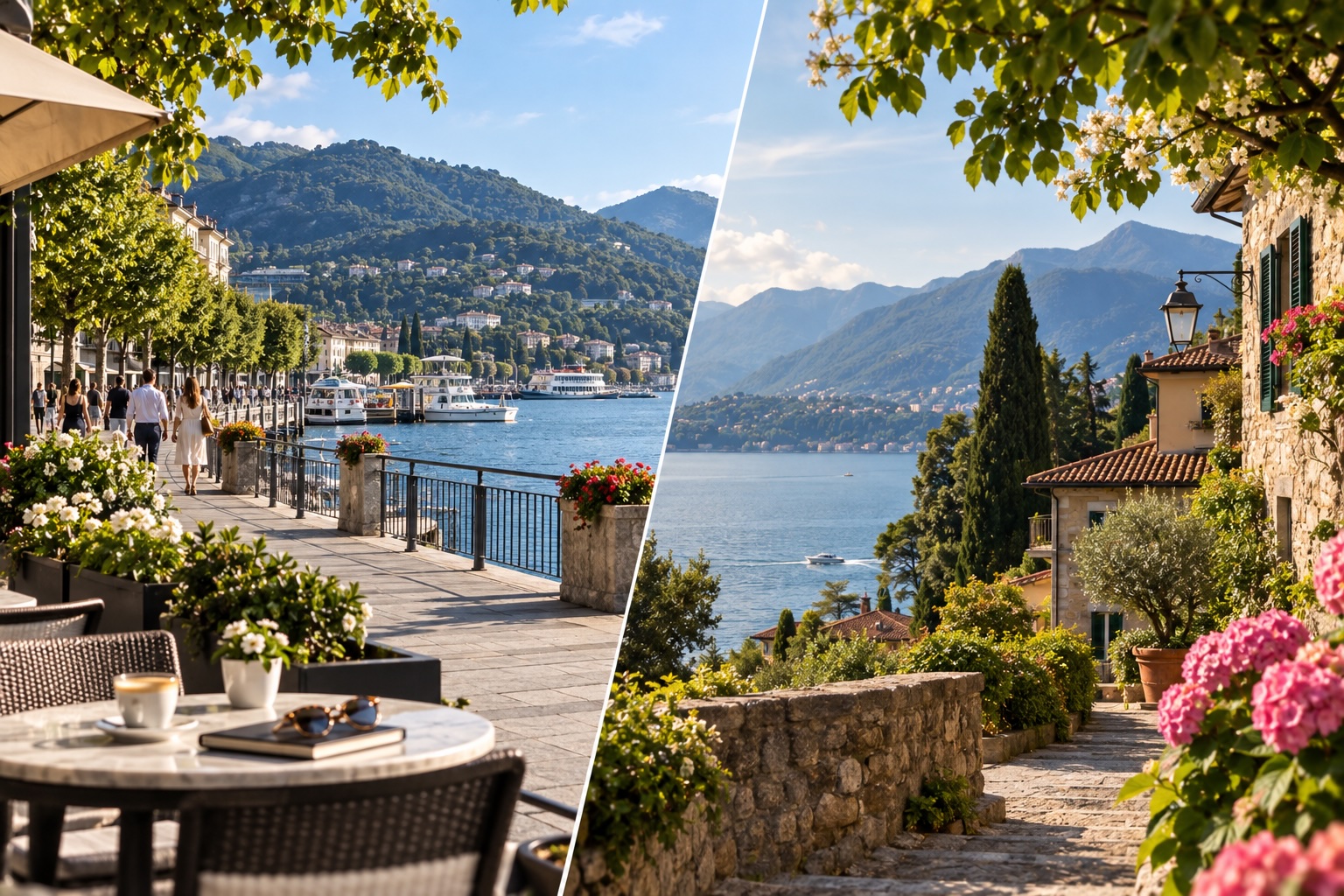
Choosing where to live on Lake Como is not simply a question of finding the most beautiful view. The entire area offers an extraordinary quality of life, but the experience can change considerably depending on whether you choose the city of Como or one of the villages scattered along the lake. Distances may appear relatively short on a map, yet everyday life can feel very different. Access to services, transport connections, privacy, walkability, social life and even the rhythm of an ordinary weekday all depend on location.
For international buyers in particular, this distinction is worth understanding before beginning a property search. The image of Lake Como seen from abroad is often dominated by waterfront villas, historic villages and spectacular landscapes. These are certainly part of its appeal, but buying a home here means choosing a place to live, not simply a postcard. A property that is perfect for long summer stays may not necessarily offer the same advantages to someone planning to spend most of the year in Italy.
Living in Como: convenience without giving up the lake
Como offers perhaps the most complete combination of urban convenience and lakeside living. It is a real city, with shops, restaurants, cafés, schools, healthcare facilities, professional services and cultural activities available throughout the year. At the same time, the lake remains an integral part of daily life. Within a relatively compact area, it is possible to move from the historic centre to the waterfront, residential neighbourhoods and green areas without feeling disconnected from the character that makes Lake Como distinctive.
For people relocating permanently, this practical dimension can be extremely important. Daily errands do not require extensive planning, there is a broad choice of services and the city remains active outside the traditional tourist season. Como is also particularly attractive to buyers who value walkability. Depending on the neighbourhood, it is possible to live without using a car for every small journey, something that can make a significant difference to everyday quality of life.
Connections are another major advantage. Como provides direct rail links towards Milan and Switzerland, while motorway access makes Milan Malpensa and the wider Lombardy region relatively accessible. For professionals who travel frequently, families with children studying elsewhere or international owners dividing their time between different countries, this connectivity can be one of the strongest arguments in favour of the city.
The property market is correspondingly varied. Historic apartments in the centre, elegant residences near the lake, contemporary developments, hillside homes and larger properties in the surrounding residential districts provide options for different lifestyles. Buyers are therefore not forced into a single interpretation of what living on Lake Como should look like.
The lake villages: space, character and a different rhythm
Move away from Como and the atmosphere gradually changes. The villages along the western and eastern shores each have their own identity, architecture and relationship with the lake. Some are internationally known and sophisticated, while others remain quieter and much more residential. What they often share is a stronger sense of separation from urban life.
For many buyers, that is precisely the attraction. Living in a lake village can offer greater privacy, a closer relationship with the landscape and a slower daily rhythm. Terraces overlooking the water, gardens, historic houses and properties surrounded by greenery become more common as the search moves beyond the city. In some locations, the sense of space and tranquillity can be remarkable despite being only a relatively short distance from Como.
There is also a particular pleasure in village life that cannot easily be measured in terms of services or travel times. Walking to the local café in the morning, recognising familiar faces, using the ferry rather than the car for certain journeys and experiencing the changing seasons directly on the lake all contribute to a lifestyle that feels distinctly different from living in a city.
However, the expression “lake village” covers very different realities. Cernobbio, for example, offers a high level of services and international appeal while remaining extremely close to Como. Other locations farther along the lake can be considerably quieter, particularly during winter. A village that is vibrant in July may have a completely different atmosphere in January. This is not necessarily a disadvantage, but it should be part of the decision.
Year-round living changes the priorities
One of the most important questions is how often the property will actually be used. Buyers looking for a second home primarily for spring and summer may reasonably prioritise views, outdoor space, proximity to the water and the atmosphere of a particular village. Someone moving permanently to Lake Como may need to look at the same property through a different lens.
Supermarkets, pharmacies, medical services, schools, parking and road access suddenly become much more relevant. So does the journey to Como, Milan or an airport. Even the orientation of a property can matter more when the home is occupied throughout the winter, as sunlight and exposure vary considerably around the lake.
This is why visiting potential locations at different times of day and, ideally, during different seasons can be extremely useful. Lake Como changes character throughout the year. Understanding how a village functions beyond the summer months provides a much clearer picture of what living there will actually mean.
The importance of mobility
Transport deserves particular attention because geography plays an unusually important role around Lake Como. Roads often follow the shoreline and travelling relatively modest distances can take longer than expected, especially during busy periods. Some villages benefit from ferry connections, others from nearby railway stations, while certain hillside locations are fundamentally car-dependent.
Como generally offers greater flexibility because several forms of transport converge around the city. In a village, the choice of property can have a much greater impact on mobility. A beautiful house positioned high above the lake may offer exceptional views and privacy but require a car for almost every activity. A smaller property in the centre of a village may sacrifice some space while allowing restaurants, shops and ferry services to be reached on foot.
Neither option is inherently better. The important point is to understand the compromise before purchasing rather than discovering it afterwards.
Privacy or immediacy?
The choice between Como and the villages often comes down to the balance between privacy and immediacy. Como places everyday life close at hand. You can leave home, walk through the historic centre, meet friends for dinner, attend an event or reach the station without organising the day around the car.
The villages can offer something different: silence, space and a stronger sense of retreat. For buyers coming from London, Paris, Zurich, New York or another major city, this contrast can be particularly appealing. A home on Lake Como can become a genuine change of pace rather than simply another urban residence in a smaller setting.
There are, of course, many intermediate solutions. Areas immediately outside Como and villages such as Cernobbio can provide considerable tranquillity while retaining easy access to the city. Conversely, some central lake locations offer restaurants, shops and ferry connections that create a surprisingly active lifestyle without the feeling of living in an urban environment.
The right property starts with the right lifestyle
It is easy to begin a Lake Como property search by comparing square metres, bedrooms, terraces and views. In reality, location should often come first. Two properties with similar characteristics can offer completely different experiences simply because one is in Como and the other is twenty or thirty kilometres farther along the lake.
Before deciding where to buy, it is therefore useful to imagine an ordinary day rather than a holiday. Where will you buy groceries? Will you want to walk to dinner? How frequently will you travel to Milan? Do you enjoy being surrounded by activity or would you rather return home to complete tranquillity? Will the property be occupied in November as well as August? Will friends and family visit regularly? How important is it to reach an airport without turning the journey into part of the trip?
For some buyers, Como provides the ideal answer because it combines Italy, the lake and a practical year-round lifestyle. For others, choosing Lake Como means deliberately moving away from the city and embracing the intimacy, landscape and slower rhythm of a village.
The best choice is not necessarily the most famous location or the property with the most dramatic view. It is the place where the way you want to live matches the way the location actually works. On Lake Como, understanding that distinction is often the first step towards finding a home that continues to feel right long after the initial beauty of the setting has become part of everyday life.