
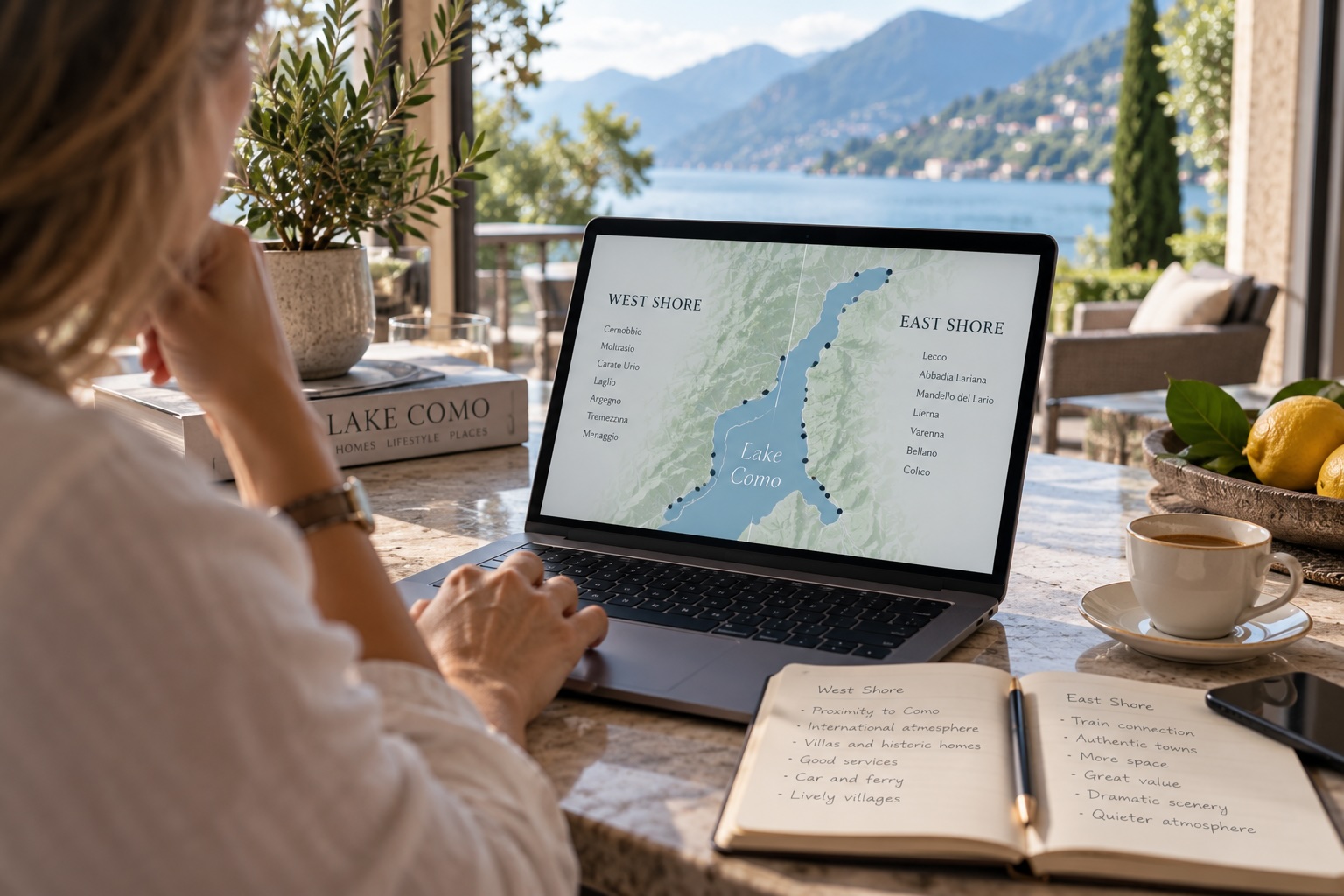
Choosing between the eastern and western shores of Lake Como is one of the most interesting decisions facing anyone considering buying a property in the area. At first glance, the distinction may seem mainly geographical. Both sides offer extraordinary landscapes, historic villages, mountain scenery and a close relationship with the water, yet everyday life can be surprisingly different. Accessibility, transport connections, property types, exposure, proximity to Como or Milan and the atmosphere of individual towns all play a role. For an international buyer, understanding these differences before concentrating on individual properties can make the search much more effective.
The western shore is traditionally the best-known side of Lake Como among international buyers. Starting from Como and travelling north, locations such as Cernobbio, Moltrasio, Carate Urio, Laglio, Argegno, Tremezzina and Menaggio have developed a strong international reputation. Historic villas, elegant residences, prestigious hotels and some of the lake’s most celebrated properties have contributed to an image recognised around the world. Yet the western shore should not be considered as a single market. Cernobbio, for example, offers a sophisticated and active environment only a short distance from Como, while moving farther north gradually introduces a quieter and more distinctly lakeside lifestyle.
One of the western shore’s main advantages is precisely its relationship with Como. The southern section of the lake allows residents to enjoy a residential setting while remaining relatively close to the city and its services. This can be particularly attractive for buyers who plan to live on Lake Como for much of the year rather than using their property exclusively as a holiday home. Restaurants, shops, healthcare, professional services and transport connections remain accessible, while returning home can still mean leaving the urban environment behind. For buyers who regularly travel towards Switzerland, the position can also be strategically convenient.
Moving farther north, the character changes again. Moltrasio, Carate Urio and Laglio offer increasingly intimate environments, while Argegno provides an important connection between the lake and the Valle Intelvi. Tremezzina and Menaggio occupy a particularly attractive position in the central lake, where ferry services make it possible to move between different destinations without relying entirely on the road. Here the lifestyle becomes less connected to Como itself and more centred on the lake as a network of villages and communities.
The eastern shore presents a different geography and, in many areas, a different way of living. Lecco, Abbadia Lariana, Mandello del Lario, Lierna, Varenna, Bellano and Colico form a long sequence of towns and villages between the mountains and the water. The landscape often feels more vertical, with steep slopes rising immediately behind the settlements and creating dramatic views across the lake. While the western shore is often associated internationally with prestigious villas and historic destinations, the eastern side combines well-known locations with towns that retain a particularly strong year-round identity.
One of its most important practical advantages is the railway. Several eastern shore towns have stations on the line connecting the area with Lecco and Milan. For certain buyers, this can fundamentally change the way a property is used. Being able to reach a second home without necessarily driving, or to travel regularly to Milan by train, adds flexibility that is not available to the same extent along much of the western shore. For international owners arriving through Milan, the possibility of combining air and rail travel can also be attractive, particularly when the property is located within walking distance or a short drive from a station.
Varenna is naturally one of the best-known locations on the eastern shore and has a particularly strong international profile. Its position in the central lake, combined with railway and ferry connections, gives it an unusual degree of accessibility for a relatively small lakeside village. However, concentrating exclusively on Varenna would overlook much of what the eastern side offers. Mandello del Lario has a substantial year-round community and practical services, Bellano combines an active town with access to the central and northern lake, while locations farther north can offer more space and a quieter environment.
Mobility is therefore one of the first factors buyers should consider when comparing the two shores. Much of the western shore depends heavily on the road network and ferry services. This is not necessarily a disadvantage for someone comfortable using a car, but travel times can change considerably according to season and traffic. The eastern shore adds the railway as another option, although this advantage depends greatly on the precise location of the property. A hillside villa several kilometres above a station will obviously offer a very different experience from an apartment in the centre of a town where the train can be reached on foot.
The real question is not which shore has better transport, but where the owner will need to travel. Someone who regularly goes to Milan may evaluate the eastern shore differently from a buyer who frequently needs to reach Como, Lugano or Switzerland. A family using the property mainly during holidays may consider both factors secondary and focus instead on access to the lake, restaurants, outdoor space and privacy. Transport should therefore be evaluated as part of the intended lifestyle rather than as an isolated characteristic of the location.
Sunlight is another factor that deserves considerably more attention than it sometimes receives during a property search. Lake Como’s complex geography means that exposure can change significantly from one village to another and even between properties within the same area. The orientation of the building, its elevation and the surrounding mountains all influence the number of hours of direct sunlight it receives. Generalisations about one shore being sunnier than the other can therefore be misleading. A home that enjoys exceptional exposure during summer may receive much less direct sunlight during winter, when the sun is lower and the mountains cast longer shadows.
For a property used primarily between spring and early autumn, this may have limited importance. For someone planning to live on Lake Como throughout the year, it can affect comfort, outdoor living and the general atmosphere of the home. Visiting a property at different times of day and understanding its winter exposure can reveal details that are impossible to appreciate from photographs or during a single summer viewing.
Property values also need to be considered locally rather than simply comparing east with west. Lake Como is a highly fragmented real estate market, where values can vary substantially within relatively short distances. A waterfront villa with private lake access, garden and parking belongs to a very different market from a hillside property in the same municipality. Views, accessibility, privacy, outdoor space, architectural quality and the condition of the building can all influence value as much as the name of the village itself.
The western shore includes several locations where international demand for prestigious properties is particularly strong and supply is naturally limited. This can support very high values for exceptional homes, especially when they combine lake access, privacy and proximity to Como. The eastern shore also has premium markets, most notably around Varenna and other desirable central-lake locations, but it can offer a broader range of opportunities in towns that are less internationally famous. For buyers prepared to look beyond the best-known names, this can open interesting possibilities without sacrificing the essential experience of living on Lake Como.
The intended use of the property can quickly clarify which locations deserve greater attention. Buyers searching for a second home may prioritise scenery, terraces, gardens, ferry connections and proximity to restaurants. The practical limitations of a quieter village may matter relatively little if the property is mainly occupied during spring and summer. Permanent residents tend to look at the same locations differently. Supermarkets, healthcare, parking, public transport and winter activity become much more important, while proximity to Como, Lecco or another substantial town can influence everyday quality of life.
Remote working has made this distinction even more interesting. Buyers who no longer need to commute every day can consider locations that might previously have seemed too distant from Milan or Como, allowing them to prioritise views, space and tranquillity without becoming completely disconnected. At the same time, internationally mobile owners still need to consider how easily they can reach an airport, railway station or motorway. A spectacular property can lose some of its appeal if every departure requires complicated logistics.
Around the central lake, the traditional east-versus-west distinction becomes less rigid. Varenna, Menaggio, Bellagio and the surrounding communities are connected by ferry, making the opposite shore part of everyday geography rather than somewhere that requires a long drive. Someone living in Varenna can cross to Menaggio or Bellagio relatively easily, while residents around Tremezzina can use the ferry network to reach other parts of the central lake. This connectivity is one of the reasons the area remains so attractive to international buyers, although the popularity of these destinations also means that certain locations become considerably busier during the main tourist season.
Ultimately, choosing between the eastern and western shores should begin with lifestyle rather than property specifications. Buyers should consider where they expect to travel most often, whether they want to walk to restaurants and shops, how important railway access is, whether they will occupy the property throughout winter and how much privacy they expect. They should also think about guests and family, airport connections and whether the home will primarily be a retreat or a base for an active life in northern Italy.
The western shore may naturally appeal to buyers who value proximity to Como, established international locations and convenient access towards Switzerland, while the eastern shore can be particularly attractive to those who appreciate railway connectivity, dramatic mountain scenery and links towards Lecco and Milan. But these remain broad distinctions. On Lake Como, the difference between two neighbouring villages can sometimes matter more than the difference between the two shores.
The right place to buy is therefore not necessarily the shore with the most famous addresses or the property with the most spectacular photograph. It is the location where accessibility, services, atmosphere and the rhythm of everyday life correspond to the way the owner genuinely intends to use the home. Once that has been established, the property search becomes much more precise, and the beauty of Lake Como becomes part of a lifestyle that works in practice as well as in imagination.